7. Utilities for observations handling
In previous notebooks, the xs.spatial.subset and xs.spatial_mean methods have already been shown, but xscen ships with a few more spatial utilities and other functions that come handy when handling observations (point timeseries).
[1]:
Let’s first create synthetic data for the example. We have here one year of daily tas data on a 50x50 grid with a Rotated Pole projection. We also have the same year of tas data at 102 “stations”.
[2]:
ds = xs.testing.datablock_3d(np.random.random((366, 50, 50)), "tas", "rlon", -25, "rlat", -25, 1, 1, "2000-01-01", as_dataset=True)
[3]:
N = 100
obs = xc.testing.helpers.test_timeseries(np.random.random(366,), 'tas', start='2000-01-01', as_dataset=True)
stations = ['00', '01'] + [''.join(random.choices(string.ascii_letters, k=4)) for i in range(N)]
lon = [-100, -100] + list(np.random.randint(-120, -60, size=N))
lat = [45, 45] + list(np.random.randint(30, 60, size=N))
obs = obs.expand_dims(station=stations).assign_coords(lon=(('station',), lon), lat=(('station',), lat))
obs
[3]:
<xarray.Dataset> Size: 304kB
Dimensions:  (station: 102, time: 366)
Coordinates:
  * station  (station) object 816B '00' '01' 'Prop' ... 'raOY' 'tYlq' 'IyWQ'
  * time     (time) datetime64[ns] 3kB 2000-01-01 2000-01-02 ... 2000-12-31
    lon      (station) int64 816B -100 -100 -107 -119 -65 ... -103 -62 -70 -101
    lat      (station) int64 816B 45 45 42 45 44 38 43 ... 34 57 32 33 39 39 43
Data variables:
tas (station, time) float64 299kB 0.7738 0.7374 ... 0.09818 0.2477.1. Merge colocated stations
You might have noticed that the “observation” data has the same coordinates for the first two stations : 00 and 01 are colocated. This can happen in real life when we merge observational datasets from multiple non-independent sources (ex: GHCNd and AHCCD), in which case the same values are repeated, or when a station changes name or has multiple instruments measuring the same variable (ex: Info-Climat), in which case one station entry as values up to a certain time before switching over to the other entry. In some context, when we consider all there sources equal, we’d want to merge them and have only one timeseries per location.
This can be done with xs.spatial.merge_duplicated_stations. It compares the lat and lon coordinates and merge all co-located elements by taking the first non-nan value along the station dimension.
[4]:
[4]:
<xarray.Dataset> Size: 295kB
Dimensions:  (station: 99, time: 366)
Coordinates:
  * station  (station) object 792B 'BIZr' 'sViF' 'BomA' ... 'LwSQ' 'lDxp' 'LcXL'
  * time     (time) datetime64[ns] 3kB 2000-01-01 2000-01-02 ... 2000-12-31
    lon      (station) int64 792B -119 -114 -119 -117 -111 ... -68 -64 -64 -65
    lat      (station) int64 792B 30 32 34 34 37 33 33 ... 34 37 35 37 37 35 30
Data variables:
    tas      (station, time) float64 290kB 0.7738 0.7374 ... 0.09818 0.247
Attributes:
history: [2026-07-06 21:09:27] Merged 3 co-located points along dimensio...7.2. Voronoi weights
When comparing observations to gridded data, one often averages some statistics over multiple stations. When done without weighting, this average treats all stations as equal, which implictely gives a stronger weight to regions with many stations. This is not always wanted. Voronoi weights are a way to enhance the geographical representativity of the average by giving less weight to stations in densely observed areas. The process divides an area with small polygons in such a way that each polygon includes exactly one station. The weights are then the fraction of the total area covered by this polygon. Further info is available on Wikipedia.
The xscen function does not store the polygons, it only returns the weight.
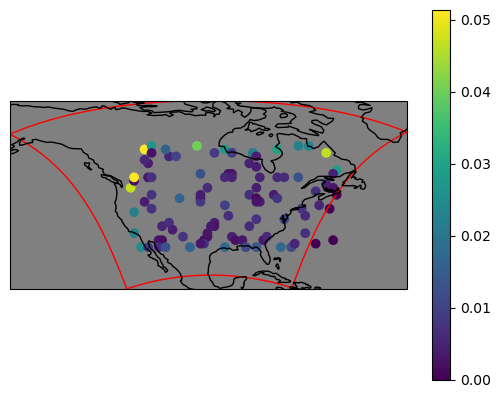
Here, we limit the voronoi polygon to the total extent of the dataset (using another handy xscen function). We could also pass a GeoDataFrame with a collection of polygons so that the weights are computed for each region. One can see in the figure that stations outside the region were attributed a weight of 0. We also limit the maximum weight to 5% (0.05) in order to lessen the impact of outlier stations.
[5]:
extent = xs.spatial.dataset_extent(ds, method='shape')
vw = xs.spatial.voronoi_weights(obs, region=extent['shape'], maxfrac=0.05)
obs = obs.assign_coords(weight=vw)
[6]:
fig, ax = plt.subplots(subplot_kw={'projection': ccrs.PlateCarree()})
sc = ax.scatter(x=obs.lon, y=obs.lat, c=obs.weight, transform=ccrs.PlateCarree())
ax.add_geometries([extent['shape']], facecolor='none', edgecolor='red', crs=ccrs.PlateCarree())
ax.coastlines()
ax.set_facecolor('grey')
bs = extent['shape'].bounds
ax.set_extent([bs[0], bs[2], bs[1], bs[3]], crs=ccrs.PlateCarree())
fig.colorbar(sc)
[6]:
<matplotlib.colorbar.Colorbar at 0x72989f4b57f0>
/home/docs/checkouts/readthedocs.org/user_builds/xscen/conda/latest/lib/python3.13/site-packages/cartopy/io/__init__.py:242: DownloadWarning: Downloading: https://naturalearth.s3.amazonaws.com/110m_physical/ne_110m_coastline.zip
If we computed some RSME, for example, we could do the average with:
[7]:
ds_at_obs = xs.spatial.subset(ds, 'gridpoint', lon=obs.lon, lat=obs.lat)
rmse = ((ds_at_obs.tas - obs.tas)**2).mean('time')**0.5
rmse.weighted(obs.weight).mean()
[7]:
<xarray.DataArray 'tas' ()> Size: 8B
array(0.40225953)
Coordinates:
    rotated_pole  <U1 4B ''